Monday, March 2, 2020

Banking Sector

Economy - Banking Sector

  • A bank is a financial institution that accepts deposits from the public and creates credit. Lending activities can be performed either directly or indirectly through capital markets.
  • Due to their importance in the financial stability of a country, banks are highly regulated in most countries.
  • Most nations have institutionalized a system known as fractional reserve banking under which banks hold liquid assets equal to only a portion of their current liabilities.
  • In addition to other regulations intended to ensure liquidity, banks are generally subject to minimum capital requirements based on an international set of capital standards, known as the Basel Accords.
Types of Banking
  1. Retail banks deal specifically with retail consumers. These banks offer services to the general public and are also called personal or general banking institutions. Retail banks provide services such as checking and savings accounts, loan and mortgage services, financing for automobiles, and short-term loans like overdraft protection. Most retail banks also offer credit card services to their customers, and may also supply their clients with foreign currency exchange. These banks also cater to high-net-worth individuals, giving them specialty services such as private banking and wealth management. Examples of retail banks include TD Bank and Citibank.
  2. Commercial or corporate banks provide specialty services to their business clients from small business owners to large, corporate entities. Along with day-to-day business banking, these banks also provide their clients with other things such as credit services, cash management, commercial real estate services, employer services, and trade finance. JPMorgan Chase and Bank of America are two popular examples of commercial banks.
  3. Investment banks focus on providing corporate clients with complex services and financial transactions such as underwriting and assisting with merger and acquisition (M&A) activity. As such, they are known primarily as financial intermediaries in most of these transactions. Clients commonly range from large corporations, other financial institutions, pension funds, governments, and hedge funds. Morgan Stanley and Goldman Sachs are examples of U.S. investment banks.
Reserve Bank of India
  • The Reserve Bank of India (RBI) is the central bank of India, which was established on April 1, 1935, under the Reserve Bank of India Act.
  • The Reserve Bank of India uses monetary policy to create financial stability in India, and it is charged with regulating the country’s currency and credit systems.
  • Located in Mumbai, the RBI serves the financial market in many ways. The bank sets the overnight interbank lending rate. The Mumbai Interbank Offer Rate (MIBOR) serves as a benchmark for interest rate–related financial instruments in India.
  • The main purpose of the RBI is to conduct consolidated supervision of the financial sector in India, which is made up of commercial banks, financial institutions, and non-banking finance firms.
  • Initiatives adopted by the RBI include restructuring bank inspections, introducing off-site surveillance of banks and financial institutions, and strengthening the role of auditors.
  • First and foremost, the RBI formulates, implements, and monitors India’s monetary policy. The bank’s management objective is to maintain price stability and ensure that credit is flowing to productive economic sectors.
  • The RBI also manages all foreign exchange under the Foreign Exchange Management Act of 1999.
  • This act allows the RBI to facilitate external trade and payments to promote the development and health of the foreign exchange market in India.
  • The RBI acts as a regulator and supervisor of the overall financial system.
  • This injects public confidence into the national financial system, protects interest rates, and provides positive banking alternatives to the public.
  • Finally, the RBI acts as the issuer of national currency.
  • For India, this means that currency is either issued or destroyed depending on its fit for current circulation. This provides the Indian public with a supply of currency in the form of dependable notes and coins, a lingering issue in India.
  • In 2018 the RBI banned the use of virtual currencies by the financial agencies and banks that it regulates.
Commercial Bank
  • A commercial bank is a type of financial institution that accepts deposits, offers checking account services, makes various loans, and offers basic financial products like certificates of deposit (CDs) and savings accounts to individuals and small businesses. A commercial bank is where most people do their banking, as opposed to an investment bank.
  • Commercial banks make money by providing loans and earning interest income from those loans. The types of loans a commercial bank can issue vary and may include mortgages, auto loans, business loans, and personal loans. A commercial bank may specialize in just one or a few types of loans.
  • Customer deposits, such as checking accounts, savings accounts, money market accounts, and CDs, provide banks with the capital to make loans. Customers who deposit money into these accounts effectively lend money to the bank and are paid interest. However, the interest rate paid by the bank on money they borrow is less than the rate charged on money they lend.
Non-Banking Financial Companies 
  • Non-banking financial companies (NBFCs) are financial institutions that offer various banking services but do not have a banking license. Generally, these institutions are not allowed to take traditional demand deposits—readily available funds, such as those in checking or savings accounts—from the public. This limitation keeps them outside the scope of conventional oversight from federal and state financial regulators.
  • NBFCs can offer banking services such as loans and credit facilities, currency exchange, retirement planning, money markets, underwriting, and merger activities.
  • NBFCs are officially classified under the 2010 Dodd-Frank Wall Street Reform and Consumer Protection Act. The Act describes them as companies "predominantly engaged in a financial activity" when more than 85% of their consolidated annual gross revenues or consolidated assets are financial in nature.
  • This classification technically encompasses a wide range of companies offering bank-like financing and investing services. Examples of NBFCs include insurance companies, money market funds, asset managers, hedge funds, private equity firms, mobile payment systems, micro-lenders, and peer-to-peer lenders.
What is difference between banks & NBFCs?
NBFCs lend and make investments and hence their activities are akin to that of banks; however there are a few differences as given below:
  • NBFC cannot accept demand deposits;
  • NBFCs do not form part of the payment and settlement system and cannot issue cheques drawn on itself;
  • Deposit insurance facility of Deposit Insurance and Credit Guarantee Corporation is not available to depositors of NBFCs, unlike in case of banks.
What are the different types/categories of NBFCs registered with RBI?
Within the broad categorization the different types of NBFCs are as follows:
  1. Asset Finance Company (AFC) 
  2. Investment Company (IC)
  3. Loan Company (LC)
  4. Infrastructure Finance Company (IFC)
  5. Systemically Important Core Investment Company (CIC-ND-SI)
  6. Infrastructure Debt Fund: Non- Banking Financial Company (IDF-NBFC)
  7. Non-Banking Financial Company - Micro Finance Institution (NBFC-MFI)
  8. Non-Banking Financial Company – Factors (NBFC-Factors)
  9. Mortgage Guarantee Companies (MGC)
  10. NBFC- Non-Operative Financial Holding Company (NOFHC)
NABARD
  • In NABARD the majority stake is held by the Reserve Bank. NABARD is an apex Development Bank with a mandate for:
    • Facilitating credit flow for promotion and development of agriculture, small-scale industries, cottage and village industries, handicrafts and other rural crafts.
    • Support all other allied economic activities in rural areas, promote integrated and sustainable rural development and secure prosperity of rural areas.
  • NABARD acts as a regulator for co-operative banks and Regional Rural Banks (RRBs).
  • NABARD also helps incapacity building of partner agencies and development institutions.
  • NABARD provide facilities for training, for dissemination of information and the promotion of research including the undertaking of studies, researches, techno-economic and other surveys in the field of rural banking, agriculture and rural development. It provides technical, legal, financial, marketing and administrative assistance to any person engaged in agriculture and rural development activities.
National Housing Bank:
National Housing Bank (NHB), a wholly owned subsidiary of Reserve Bank of India (RBI), was set up on 9 July 1988 under the National Housing Bank Act, 1987.
 NHB is an apex financial institution for housing. NHB has been established with an objective to operate as a principal agency to promote housing finance institutions both at local and regional levels and to provide financial and other support incidental to such institutions and for matters connected therewith.
NHB registers, regulates and supervises Housing Finance Company (HFCs), keeps surveillance through On-site & Off-site Mechanisms and co-ordinates with other Regulators.
Small Industries Development Bank of India (SIDBI)
  • Small Industries Development Bank of India (SIDBI) is a development financial institution in India, headquartered at Lucknow and having its offices all over the country.
  • Its purpose is to provide refinance facilities and short term lending to industries, and serves as the principal financial institution in the Micro, Small and Medium Enterprises (MSME) sector.
  • SIDBI also coordinates the functions of institutions engaged in similar activities. SIDBI operates under the Department of Financial Services, Government of India.
  • SIDBI is one of the four All India Financial Institutions regulated and supervised by the Reserve Bank; other three are EXIM Bank, NABARD and NHB. They play a salutary role in the financial markets through credit extension and refinancing operation activities and cater to the long-term financing needs of the industrial sector.
  • SIDBI is active in the development of Micro Finance Institutions through SIDBI Foundation for Micro Credit, and assists in extending micro-finance through the Micro Finance Institution (MFI) route. Its promotion & development program focuses on rural enterprises promotion and entrepreneurship development.
Micro Units Development and Refinance Agency Bank (MUDRA Bank):
  • It is a public sector financial institution in India. It provides loans at low rates to micro-finance institutions and non-banking financial institutions which then provide credit to MSMEs.
  • The Industrial Investment Bank of India (IIBI) The Industrial Investment Bank of India was a 100% government of India-owned financial investment institution.
  • It was established in 1971 by resolution of the Parliament of India u/s 617 of the Companies Act.
  • The bank was headquartered at Kolkata and had presence in New Delhi, Mumbai, Chennai, Bengaluru, Ahmedabad and Guwahati.
  • The Industrial Reconstruction Corporation of India Ltd., set up in 1971 for rehabilitation of sick industrial companies, was reconstituted as Industrial Reconstruction Bank of India in 1985 under the IRBI Act, 1984.
  • With a view to converting the institution into a full-fledged development financial institution, IRBI was incorporated under the Companies Act 1956, as Industrial Investment Bank of India Ltd. (IIBI) in March 1997.
  • IIBI offered a wide range of products and services, including term loan assistance for project finance, short duration non-project asset-backed financing, working capital/other short-term loans to companies, equity subscription, asset credit, equipment finance and investments in capital market and money market instruments.
  • In 2005, a merger of IIBI, IDBI and IFCI was considered, but IIBI refused and it was decided in 2006-2007 to close the bank.
  • As of 2011, the bank operated from its sole remaining office in Kolkata.
  • Deloitte and Touché was appointed to dispose of IIBI’s Non-Performing assets. The bank’s closure was announced in the Budget 2012.
IFCI
  • IFCI, previously Industrial Finance Corporation of India, is a Non-Banking Finance Company in the public sector.
  • Established in 1948 as a statutory corporation, IFCI is currently a company listed on BSE and NSE.
  • IFCI manages seven numbers of subsidiaries and one associate under its fold.
  • It provides financial support for the diversified growth of Industries across the spectrum.
  • The financing activities cover various kinds of projects such as airports, roads, telecom, power, real estate, manufacturing, services sector and such other allied industries.
  • The company has played a pivotal role in setting up various market intermediaries of repute in several niche areas like stock exchanges, entrepreneurship development organizations, consultancy organizations, educational and skill development institutes across the length and breadth of the country.
Export-Import Bank of India:
  • Export–Import Bank of India is the premier export finance institution in India, established in 1982 under Export-Import Bank of India Act 1981.
  • Since its inception, Exim Bank of India has been both a catalyst and a key player in the promotion of cross border trade and investment.
  • Commencing operations as a purveyor of export credit, like other export credit agencies in the world, Exim Bank India has, over the period, evolved into an institution that plays a major role in partnering Indian industries, particularly the Small and Medium Enterprises, in their globalization efforts, through a wide range of products and services offered at all stages of the business cycle, starting from import of technology and export product development to export production, export marketing, pre-shipment and post-shipment and overseas investment.
Co-operative banks:
  • Co-operative banks are small-sized units organized in the co-operative sector which operate both in urban and non-urban centers.
  • Co-operative Banks in India are registered under the Co-operative Societies Act.
  • The cooperative bank is also regulated by the RBI. T
  • hey are governed by the Banking Regulations Act 1949 and Banking Laws (Co-operative Societies) Act, 1965.
  • Cooperative Banks in India have become an integral part of the success of Indian Financial Inclusion story.
  • They have achieved many landmarks since their creation and have helped a normal rural Indian to feel empowered and secure. The story has not been smooth and has its share of procedural glitches and woes placed at various pockets
Extent of Cooperative Banking
  • Indian cooperative structures are one of the largest such networks in the world with more than 200 million members. It has about 67% penetration in villages and fund 46% of the total rural credit. It also stands for 36% of the total distribution of rural fertilizers and 28% of rural fair price shops.
Structure of Cooperative Banking in India
  • The structure of cooperative network in India can be divided into 2 broad segments-
    • Urban Cooperative Banks
    • Rural Cooperatives
Urban Cooperatives
  • Urban Cooperatives can be further divided into scheduled and non-scheduled.
  • Both the categories are further divided into multi-state and single-state.
  • Majority of these banks fall in the non-scheduled and single-state category.
  • Banking activities of Urban Cooperative Banks are monitored by RBI.
  • Registration and Management activities are managed by Registrar of Cooperative Societies (RCS).
  • These RCS operate in single-state and Central RCS (CRCS) operate in multiple state.
Rural Cooperatives
  • The rural cooperatives are further divided into short-term and long-term structures.
  • The short-term cooperative banks are three tiered operating in different states. These are
    • State Cooperative Banks- They operate at the apex level in states
    • District Central Cooperative Banks-They operate at the district levels
    • Primary Agricultural Credit Societies-They operate at the village or grass-root level.
  • Likewise, the long-term structures are further divided into –
    • State Cooperative Agriculture and Rural Development Banks (SCARDS) - These operate at state-level.
    • Primary Cooperative Agriculture and Rural Development Banks (PCARDBS)-They operate at district/ block level.
  • The rural banking cooperatives have a complex monitoring structure as they have a dual control which has led to many problems. A Forum called State Level Task Force on Cooperative Urban Banks (TAFCUB) has been set-up to look into issues related to duality in control.
    • All banking activities are regulated by a shared arrangement between RBI and NABARD.
    • All management and registration activities are managed by RCS
Public Sector Bank recapitalization
  • The Government approved to provide an additional amount of Rs. 6000 crore, in addition to the Rs. 15000 crore already provided in the Budget 2010-11, to ensure Tier I CRAR (Capital to Risk Weighted Assets) of Public Sector Banks (PSBs) and also to raise Government of India holding in all PSBs to 58%. The proposed capital infusion would enhance the lending capacity of the PSBs to meet the credit requirement of the economy in order to maintain and accelerate the economic growth momentum. This additional, availability of capital is likely to benefit employment oriented sectors, especially agriculture, micro & small enterprises, export, entrepreneurs etc.
  • During the recent global financial crisis, the Public Sector Banks (PSBs) played a pivotal role in the economy by extending credit to all the productive sectors of the economy. These banks, in this backdrop, would require capital commensurate with the increase in there. Risk Weighted Assets (RWAs). Though the minimum regulatory requirement of Capital to Risk Weighted Assets (CRAR) for the banks is 9%, the Government has mandated a total CRAR of 12% with 8% Tier I Capital. Keeping, all other factors, the Finance Minister, in his Budget speech for the year 2010-11 announced that capital would be infused in the PSBs so that these are able to attain a minimum & percent Tier I Capital by 31st March, 2011.
  • There are many PSBs where the Government of India’s holding is close to 51%. This implies that in case of need, these banks cannot access the capital market for raising additional capital by dilution of Government holding. The present capitalization process of the PSBs has presented an opportunity to the Government to raise its shareholding in the PSBs, especially in those PSBs where the Government’s holding is close to 51%. This will enable the PSBs to raise additional capital from the market, in future, without depending upon the Government.
  • Recapitalization is a process of changing a firm’s capital structure by altering the mix of debt and equity financing without changing the total amount of capital.
Differential Banks
Small Finance Banks and Payment Banks Criteria
  • The Reserve Bank of India (RBI) issues licenses to entities to carry on the business of banking and other business in which banking companies may engage, as defined and described in Sections 5 (b) and 6 (1) (a) to (o) of the Banking Regulation Act, 1949, respectively.
  • RBI has come up with guidelines for two new categories of banks- ‘small and payments banks’ and states that these can improve financial inclusion.
Small Finance Banks
  • The objectives of setting up of small finance banks will be to further financial inclusion by (a) provision of savings vehicles, and (ii) supply of credit to small business units; small and marginal farmers; micro and small industries; and other unorganized sector entities, through high technology-low cost operations.
  • Eligible Promoters: Resident individuals/professionals with 10 years of experience in banking and finance; and companies and societies owned and controlled by residents will be eligible to set up small finance banks. Existing Non-Banking Finance Companies (NBFCs), Micro Finance Institutions (MFIs), and Local Area Banks (LABs) that are owned and controlled by residents can also opt for conversion into small finance banks. Promoter/promoter groups should be ‘fit and proper’ with a sound track record of professional experience or of running their businesses for at least a period of five years in order to be eligible to promote small finance banks.
Payment Banks:
The primary objective of setting up of Payments Banks will be to further financial inclusion by providing  (i) small savings accounts and (ii) payments / remittance services to migrant labour workforce, low income households, small businesses, other unorganised sector entities and other users, by enabling high volume low value transactions in deposits and payments / remittance services in a secured technology-driven environment.
Registration, Licensing and Regulations
  • The Payments Bank will be registered as a public limited company under the Companies Act, 2013, and licensed under Section 22 of the Banking Regulation Act, 1949, with specific licensing conditions restricting its activities to acceptance of demand deposits and provision of payments and remittance services.
Eligibility Criteria
  • The existing non-bank PPI issuers authorized under the Payment and Settlement Systems Act, 2007 (PSS Act) and other entities such as Non-Banking Finance Companies (NBFCs), corporate BCs, mobile telephone companies, super-market chains, companies, real sector cooperatives and public sector entities may apply to set up a Payments Bank. Even banks can take equity stake in a Payments Bank to the extent permitted under Section 19 (2) of the Banking Regulation Act, 1949.
Scope of Activities 
  • The Payments Bank will be set up as a differentiated bank and shall confine its activities to further the objectives for which it is set up. Therefore, the Payments Bank would be permitted to undertake only certain restricted activities permitted to banks under the Banking Regulation Act, 1949, as given below:
  • Acceptance of demand deposits, i.e., current deposits, and savings bank deposits. The eligible deposits mobilized by the Payments Bank would be covered under the deposit insurance scheme of the Deposit Insurance and Credit Guarantee Corporation of India (DICGC). Given that their primary role is to provide payments and remittance services and demand deposit products to small businesses and low-income households, Payments Banks will initially be restricted to holding a maximum balance of Rs. 100,000 per customer.
  • Payments and remittance services through various channels including branches, BCs and mobile banking. The payments remittance services would include acceptance of funds at one end through various channels including branches and BCs and payments of cash at the other end, through branches, BCs, and Automated Teller Machines (ATMs). Cash-out can also be permitted at Point-of Sale terminal locations as per extant instructions issued under the PSS Act. In the case of walk-in customers, the bank should follow the extant KYC guidelines issued by the RBI.
  • Issuance of PPIs as per instructions issued from time to time under the PSS Act.
  • Internet banking - The RBI is also open to applicants transacting primarily using the Internet. The Payments Bank is expected to leverage technology to offer low cost banking solutions. Such a bank should ensure that it has all enabling systems in place including business partners, third party service providers and risk managements systems and controls to enable offering transactional services on the internet. While offering such services, the Payments Bank will be required to comply with RBI instructions on information security, electronic banking, technology risk management and cyber frauds.
  • Functioning as Business Correspondent (BC) of other banks - A Payments Bank may choose to become a BC of another bank for credit and other services which it cannot offer.
    • The Payments Bank cannot set up subsidiaries to undertake non-banking financial services activities. The other financial and non-financial services activities of the promoters, if any, should be kept distinctly ring-fenced and not co-mingled with the banking and financial services  of the Payments Bank.
    • The Payments Bank will be required to use the word “Payments” in its name in order to differentiate it from other banks
Deployment of Funds
  • The Payments Bank cannot undertake lending activities. Apart from amounts maintained as Cash Reserve Ratio (CRR) with RBI, minimum cash in hand and balances with a scheduled commercial bank/RBI required for operational activities and liquidity management, it will be required to invest all its monies in Government securities/Treasury Bills with maturity up to one year that are recognized by RBI as eligible securities for maintenance of Statutory Liquidity Ratio (SLR). The Payments Bank will participate in the payment and settlement system and will have access to the inter-bank uncollateralized call money market and the collateralized CBLO market for purposes of temporary liquidity management.
Capital Requirement
  • Since the Payments Bank will not be allowed to assume any credit risk, and if its investments are held to maturity, such investments need not be marked to market and there may not be any need for capital for market risk.
  • However, the Payments Bank will be exposed to operational risk. The Payments Bank will also be required to invest heavily in technological infrastructure for its operations. The capital will be utilized for creation of such fixed assets. Therefore, the minimum paid up voting equity capital of the Payments Bank shall be Rs. 100 crore.
  • Any additional voting equity capital to be brought in will depend on the business plan of the promoters. Further, the Payments Bank should have a net worth of Rs. 100 crore at all times.
  • The Payments Bank shall be required to maintain a minimum capital adequacy ratio of 15 per cent of its risk weighted assets (RWA) on a continuous basis, subject to any higher percentage as may be prescribed by RBI from time to time.
  • However, as Payments Banks are not expected to deal with sophisticated products, the capital adequacy ratio will be computed under simplified Basel I standards.
  • As the Payments Bank will have almost zero or negligible risk weighted assets, its compliance with a minimum capital adequacy ratio of 15 per cent would not reflect the true risk.
  • Therefore, as a backstop measure, the Payments Bank should have a leverage ratio of not less than 5 per cent, i.e., its outside liabilities should not exceed 20 times its net-worth / paid-up capital and reserves.
Mission Indradhanush for revamping Public Sector Banks
  • The mission includes the seven key reforms of appointments, board of bureau, capitalisation, de-stressing, empowerment, framework of accountability and governance reforms.
  • The mission includes:
    • Appointments: Executives from the private sector have been hired to run state-owned banks with the government.
    • Bank Board Bureau: The Bank Board Bureau will start functioning from the next financial year and is the first step toward a full-fledged bank holding company, an entity that will house the government’s stake in state run banks struggling with mounting non-performing loans that have touched 6 per cent of gross advances.
    • Capitalization: The government will inject a total of Rs 25,000 crore of capital into debt-laden state banks in this fiscal; Rs 20,000 crore would be injected in a month. Over the next four years, the government plans to inject Rs 70,000 crore.
    • De-stressing: The government will concentrate on distressing the banks’ bad loans.
    • Empowerment: The government will strive to make it easier for PSBs to hire. The government is looking at introducing Employee Stock Ownership Plan (ESOPs) for the PSU bank managements.
    • Framework of Accountability: The government also announced a new framework of key performance indicators for state-run lenders to boost efficiency in functioning while assuring them of independence in decision making on purely commercial considerations.
    • Governance Reforms: The process of governance reforms started with “Gyan Sangam” - a conclave of PSBs and FIs organized at the beginning of 2015 in Pune which was attended by all stake-holders including Prime Minister, Finance Minister, MoS (Finance), Governor, RBI and CMDs of all PSBs and FIs. There was focus group discussion on six different topics which resulted in specific decisions on optimizing capital, digitizing processes, strengthening risk management, improving managerial performance and financial inclusion.
Basel III Norms
  • Basel III is an international regulatory accord that introduced a set of reforms designed to improve the regulation, supervision and risk management within the banking sector.
  • The Basel Committee on Banking Supervision published the first version of Basel III in late 2009, giving banks approximately three years to satisfy all requirements.
  • Largely in response to the credit crisis, banks are required to maintain proper leverage ratios and meet certain minimum capital requirements.
  • Basel III is part of the continuous effort to enhance the banking regulatory framework.
  • It builds on the Basel I and Basel II documents, and seeks to improve the banking sector's ability to deal with financial stress, improve risk management, and strengthen the banks' transparency. A focus of Basel III is to foster greater resilience at the individual bank level in order to reduce the risk of system-wide shocks.
Minimum Capital Requirement
  • Basel III introduced tighter capital requirements in comparison to Basel I and Basel II. Banks' regulatory capital is divided into Tier 1 and Tier 2, while Tier 1 is subdivided into Common Equity Tier 1 and additional Tier 1 capital. The distinction is important because security instruments included in Tier 1 capital have the highest level of subordination. Common Equity Tier 1 capital includes equity instruments that have discretionary dividends and no maturity, while additional Tier 1 capital comprises securities that are subordinated to most subordinated debt, have no maturity, and their dividends can be cancelled at any time. Tier 2 capital consists of unsecured subordinated debt with an original maturity of at least five years.
  • Basel III left the guidelines for risk-weighted assets largely unchanged from Basel II. Risk-weighted assets represent a bank's assets weighted by coefficients of risk set forth by Basel III. The higher the credit risk of an asset, the higher its risk weight. Basel III uses credit ratings of certain assets to establish their risk coefficients.
  • In comparison to Basel II, Basel III strengthened regulatory capital ratios, which are computed as a percent of risk-weighted assets. In particular, Basel III increased minimum Common Equity Tier 1 capital from 4% to 4.5%, and minimum Tier 1 capital from 4% to 6%. The overall regulatory capital was left unchanged at 8%.
Countercyclical Measures
  • Basel III introduced new requirements with respect to regulatory capital for large banks to cushion against cyclical changes on their balance sheets.
  • During credit expansion, banks have to set aside additional capital, while during the credit contraction, capital requirements can be loosened.
  • The new guidelines also introduced the bucketing method, in which banks are grouped according to their size, complexity and importance to the overall economy.
  • Systematically important banks are subject to higher capital requirements.

Basics of Economy

Economy - Basics of Economy

National Income Definition
  • National income is the total value of a country’s final output of all new goods and services produced in one year. However, there are practical difficulties in estimating the national income as per this concept; hence we use the Pigouvian definition.
  • C. Pigou has in his definition of national income included that income which can be measured in terms of money. In the words of Pigou, “National income is that part of objective income of the community, including the income derived from abroad which can be measured in monetary terms.”
National Income Concepts
Gross Domestic Product at Market Prices (GDPMP )
  • GDP is the market value of all final goods and services produced within a domestic territory of a country measured in a year. •
  • All production done by the national residents or the non-residents in a country gets included, regardless of whether that production is owned by a local company or a foreign entity.
  • Everything is valued at market prices.
  • GDP MP = C+ I +G +X –M
GDP at Factor Cost (GDPFC)
  • GDP at factor cost is gross domestic product at market prices, less net product taxes.
  • Market prices are the prices as paid by the consumers Market prices also include product taxes and subsides. The term factor cost refers to the prices of products as received by the producers. Thus, factor cost is equal to market prices, minus net indirect taxes. GDP at factor cost measures money value of output produced by the firms within the domestic boundaries of a country in a year.
  • GDPFC =GDPMP –NIT
Net Domestic Product at Market Prices (NDPMP)
  • This measure allows policy-makers to estimate how much the country has to spend just to maintain their current GDP. If the country is not able to replace the capital stock lost through depreciation, then GDP will fall.
  • NDP MP =GDP MP –DEP
NDP at Factor Cost (NDPFC)
  • NDP at factor cost is the income earned by the factors in the form of wages, profits, rent, interest, etc., within the domestic territory of a country.
  • NDPFC =NDPMP -Net ProductTaxes-Net ProductionTaxes
Gross National Product at Market Prices (GNPMP)
  • GNPMP is the value of all the final goods and services that are produced by the normal residents of India and is measured at the market prices, in a year.
  • GNP refers to all the economic output produced by a nation’s normal residents, whether they are located within the national boundary or abroad.
  • Everything is valued at the market prices.
  • GNPMP= GDP MP + NFIA
GNP at Factor Cost (GNPFC)
  • GNP at factor cost measures value of output received by the factors of production belonging to a country in a year.
  • GNP FC =GNP MP -Net ProductTaxes-Net ProductionTaxes
Net National Product at Market Prices (NNPMP)
  • This is a measure of how much a country can consume in a given period of time. NNP measures output regardless of where that production has taken place (in domestic territory or abroad).
  • NNPMP =GNPMP –Depreciation
  • NNPMP= NDPMP+ NFIA
NNP at Factor Cost (NNPFC)
  • NNP at factor cost is the sum of income earned by all factors in the production in the form of wages, profits, rent and interest, etc., belonging to a country during a year.
  • It is the National Product and is not bound by production in the national boundaries. It is the net domestic factor income added with the net factor income from abroad.
  • NI =NNPMP - Net ProductTaxes-Net ProductionTaxes
GVA at basic prices
  • GVAMP - Net Product Taxes
GVA at factor cost
  • GVA at basic prices - Net Production Taxes

Three Measurements of National Income
National Income calculated by three ways:
Consider the following while calculating National Income through:
Value Added Method (or the Product Method)
  • The value added or production method is used by economists to calculate GDP at market prices, which is the total values of outputs produced at different stages of production. It needs to be mentioned that caution should be taken to take final Goods and not Intermediate goods, as it will result in Double Counting.
  • Some of the goods and services included in production are:
    • Goods and services actually sold in the market.
    • Goods and services not sold but supplied free of cost. (No Charge/Complementary
  • Some of the goods and services not included in production are:
    • Second hand items and purchase and sale of the same. Sale and purchase of second cars, for example, are not a part of GDP calculation as no new production takes place in the economy.
    • Production due to unwarranted/ illegal activities.
    • Non-economic goods or natural goods such as air and water.
    • Transfer Payments such as scholarships, pensions etc. are excluded as there is income received, but no good or service is produced in return.
    • Imputed rental for owner-occupied housing is also excluded
Income Method 
  • This method emphasises on aggregating the payments made by firms to households, called factor payments.
  • It is defined as total income earned by citizens and businesses of a country. There are four types of factors of production and four types of factor incomes accordingly i.e. Land, Labour, Capital and Entrepreneur/Organization as Factors of Production and Rent, Wages, Interest and Profit as Factor Incomes correspondingly.
  • GDP = Wages+ Interest Income + Rental Income +Profit +Indirect Taxes-Subsidies+ Depreciation
  • The term Profit can be further sub-divided into: profit tax; dividend to all those shareholders; and retained profit (or retained earnings).
  • Such an approach is adopted in India to calculate the contribution of services sector to the economy.
  • Any income corresponding to which there is no flow of goods and services or value added, it should not be included in calculation by Income method.
Expenditure Method
  • The expenditure method measures the final expenditure on GDP. Amount of Expenditure refers to all spending on currently-produced final goods and services only in an economy. In an economy, there are three main agencies, which buy goods and services. These are: Households, Firms and the Government
  • This final expenditure is made up of the sum of four expenditure items, namely:
  • Consumption (C): Personal Consumption made by households, the payment of which is paid by households directly to the firms which produced the goods and services desired by the households.
  • Investment Expenditure (I): Investment is an addition to capital stock of an economy in a given time period. This includes investments by firms as well as governments sectors
  • Government Expenditure (G): This category includes the value of goods and service purchased by Government. Government expenditure on pension schemes, scholarships, unemployment allowances etc. are not included in this as all of them come under transfer payments.
  • Net Exports (X-IM): Expenditure on foreign made products (Imports) are expenditure that escapes the system, and must be subtracted from total expenditures. In turn, goods produced by domestic firms which are demanded by foreign economies involve expenditure by other economies on our production (Exports), and are included in total expenditure. The combination of the two gives Net Exports.
GDP= C+I+G+X-IM C = consumption 
I = Investment
G = Government expenditure
X = Export 
IM = Import
What are the factors that affect National Income?
Several factors affect the national income of a country. Some of them have been listed below:
Factors of Production
Normally, the more efficient and richer the resources, higher will be the level of National Income or GNP.
1. Land
Resources like coal, iron and timber are essential for heavy industries so that they must be available and accessible. In other words, the geographical location of these natural resources affects the level of GNP.
2. Capital
Capital is generally determined by investment. Investment in turn depends on other factors like profitability, political stability, etc.
3. Labour
The quality or productivity of human resources is more important than quantity. Manpower planning and education affect the productivity and production capacity of an economy.
4. Entreprise
The size of the national income also greatly depends upon the number and skill of the entrepreneurs. If the captains of the industries! are efficient, they will combine; the various factors of production to the optimum proportion and so the volume of total production will be quite large, if managerial skill is lacking in the country, the size of the national income will be small.
5. Technology
This factor is more important for Nations with fewer natural resources. The development in technology is affected by the level of invention and innovation in production.
6. Government
Government can help to provide a favourable business environment for investment. It provides law and order, regulations.
7. Political Stability
A stable economy and political system helps in appropriate allocation of resources. Wars, strikes and social unrests will discourage investment and business activities.
New Methodology for Calculation of GDP in India
  • Earlier domestic GDP was calculated at factor or basic cost, which took into account prices of products received by producers.
  • The new formula takes into account market prices paid by consumers. It is calculated by adding GDP at factor price and indirect taxes (minus subsidies). It is in line with international practice and is expected to better capture the changing structure of the Indian economy.
  • The government has also changed the base year for estimating GDP from 2004-05 to 2011-12. This has been done to incorporate the changing structure of the economy, especially rural India.
  • Data for the new GDP series will now be collected from 5 lakh companies (against 2,500 companies earlier). Under-represented and informal sectors as well as items such as smartphones and LED television sets will now be taken into account to calculate the gross domestic product.
Green GDP
  • Green GDP is a term used generally for expressing GDP after adjusting for environmental damage. When information on economy’s use of the natural environment is integrated into the system of national accounts, it becomes green national accounts or environmental accounting.
  • The process of environmental accounting involves three steps viz. Physical accounting; monetary valuation; and integration with national Income/wealth Accounts. Physical accounting determines the state of the resources, types, and extent (qualitative and quantitative) in spatial and temporal terms. Monetary valuation is done to determine its tangible and intangible components. Thereafter, the net change in natural resources in monetary terms is integrated into the Gross Domestic Product in order to reach the value of Green GDP.

STATE OF FOREST Report 2019

Environment - STATE OF FOREST Report 2019

Introduction
  • The report is published by the Forest Survey of India (FSI) which has been mandated to assess the forest and tree resources of the country including wall-to-wall forest cover mapping in a biennial cycle.
  • Starting 1987, 16 assessments have been completed so far. ISFR 2019 is the 16th report in the series.
  • India is among few countries in the world where forest cover is consistently increasing.
  • The total forest and tree cover of the country is 80.73 million hectare which is 24.56 percent of the geographical area of the country.
  • Compared to the assessment of 2017, there is an increase of 5,188 sq. km in the total forest and tree cover of the country.
  • Out of this, the increase in the forest cover has been observed as 3,976 sq km and that in tree cover is 1,212 sq. km; Range increase in forest cover has been observed in open forest followed by very dense forest and moderately dense forest and the top three states showing increase in forest cover are Karnataka (1,025 sq. km) followed by Andhra Pradesh (990 sq km) and Kerala (823 sq km).”
Some Major Findings of the report
  • Area-wise Madhya Pradesh has the largest forest cover in the country followed by Arunachal Pradesh, Chhattisgarh, Odisha and Maharashtra.
  • In terms of forest cover as percentage of total geographical area, the top five States are Mizoram (85.41%), Arunachal Pradesh (79.63%), Meghalaya (76.33%), Manipur (75.46%) and Nagaland (75.31%).
  • The Mangrove ecosystems are unique & rich in biodiversity and they provide numerous ecological services.
  • Mangrove cover has been separately reported in the ISFR 2019 and the total mangrove cover in the country is 4,975 sq km.
  • An increase of 54 sq Km in mangrove cover has been observed as compared to the previous assessment of 2017.
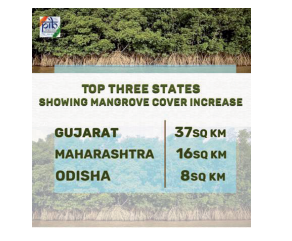
  • Top three states showing mangrove cover increase are Gujarat (37 sq km) followed by Maharashtra (16 sq km) and Odisha (8 sq km).
      
  • The total growing stock of India’s forest and TOF is estimated 5,915.76 million come of which 4,273.47 million come is inside the forests and 1,642.29 million come outside.
  • There is an increase of 93.38 million come of total growing stock, as compared to the previous assessment.
  • Out of this the increase in growing stock, there is an increase of 55.08 million come inside the forests and 38.30 million come outside the forest areas.
  • The extent of bamboo bearing area of the country has been estimated 16.00 million hectare.
  • There is an increase of 0.32 million hectare in bamboo bearing area as compared to the last assessment of ISFR 2017.
  • The total estimated green weight of bamboo culms is 278 million tonnes, slowly an increase of 88 million tonnes as compared to ISFR 2017.
  • Under the current assessment the total carbon stock in country’s forest is estimated 7,124.6 million tonnes and there an increase of 42.6 million tonnes in the carbon stock of country as compared to the last assessment of 2017.
  • The annual increase in the carbon stock is 21.3 million tonnes, which is 78.2 million tonnes CO2 eq.
  • Wetlands within forest areas form important ecosystems and add richness to the biodiversity in forest areas, both of faunal and floral species. Due to importance of wetlands, FSI has carried out an exercise at the national level to identify wetlands of more than 1 ha within RFA.
  • There are 62,466 wetlands covering 3.8% of the area within the RFA/GW of the country
Methodology
  • In tune with the Government of India’s vision of Digital India, FSI’s assessment is largely based on digital data whether it is satellite data, vector boundaries of districts or data processing of field measurements.
  • The report provides information on forest cover, tree cover, mangrove cover, growing stock inside and outside the forest areas, carbon stock in India’s forests, Forest Types and Biodiversity, Forest Fire monitoring and forest cover in different slopes & altitudes.
  • Special thematic information on forest cover such as hill, tribal districts, and north eastern region has also been given separately in the report.
  • The biennial assessment of forest cover of the country using mid-resolution Satellite data is based on interpretation of LISS-III data from Indian Remote Sensing satellite data Resourcesat-II.
  • This information provides inputs for various global level inventories, reports such as GHG Inventory, Growing Stock, Carbon Stock, Forest Reference Level (FRL) and international reporting to UNFCCC, targets under CCD, Global Forest Resource Assessment (GFRA) done by FAO for planning and scientific management of forests.
  • For the first time, Ortho-rectified satellite data has been used for forest cover mapping due to its better positional accuracy as it removes effects of image perspective (tilt) and relief (terrain) and scale distortions in the image to represent features in its true positions for accurate measurement of distances, angels and areas.
  • FSI, in a first ever attempt has carried out a rapid assessment of biodiversity for all the States and UTs (except two) and for all the sixteen Forest Type Groups as per Champion & Seth Classification (1968).
  • Apart from the number of tree, shrub and herb species as observed in the survey, Shanon Wienner Index which gives species richness along with the relative abundance, has also been calculated for each forest type groups in each State & UT.
  • FSI has carried out mapping of forest types of India as per the Champion & Seth Classification (1968), for the first time in the year 2011 based on the base line forest cover data of 2005.
Other Highlights
  • A study to assess the dependence of the people living in close proximity to forests for their day to day needs like fuel wood, fodder, small timber and bamboo was undertaken by FSI.
  • The present report also gives information on the fire prone forest areas of different severity classes, mapped in the grids of 5km x 5km based on the frequency of forest fires in the last 14 years that would enable the SFDs to manage and control forest fires effectively in the respective States.
  • Non Timber Forest Produce (NTFP) are important source of livelihood for many tribal communities and villagers living in the proximity of forests.
  • New information has been generated from the national forest inventory data about the top five NTFP species in each State & UT in terms of their availability in forests i.e. relative occurrence.
  • Invasive species pose serious threat to the sustainable management of forests. Analysis of NFI data has been done for determining five major invasive species in each State & UT and also an estimate of area affected by them.
  • The information given in the report would provide valuable information for policy, planning and sustainable management of forest and tree resources in the country.
India’s Forests and Forest Resources in the World
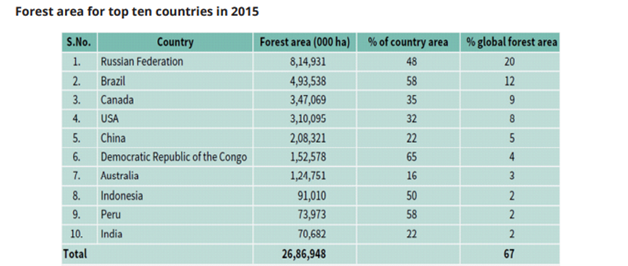
  • Global Forest Resource Assessment (FRA) done by FAO once in five years provides information about the forest resources of almost all the countries in the world.
  • The latest report of GFRA has been released by FAO in the year 2015.
  • Status of the top ten to twelve countries in respect of forest area, change in forest area, growing stock and forest carbon as per the GFRA 2015 are presented as follows.

Objectives of the Nation-Wide Forest Cover Mapping
  • To monitor forest cover and changes therein at the National, State and District levels
  • To generate information on forest cover in different density classes and changes therein
  • To produce forest cover and other thematic maps derived from it for the whole country
  • To provide primary base layer for assessment of different parameters including growing stock, forest carbon etc
  • To provide information for international reporting
Limitations of the Forest Cover Mapping
  • Since the resolution of the LISS III sensor data is 23.5 m, land cover features having a geometric dimension less than 23.5 m on the ground are not discernible.
  • Considerable ground details may sometimes be obscured due to clouds and shadows. Such areas can be discerned to a certain extent with the help of collateral data and image processing techniques, but not always.
  • Non-availability of appropriate season data sometimes puts constraints on the interpretation of the features owing to poor reflectance of data and phenological changes in forests.
  • Occurrence of weeds like lantana in forest areas and agricultural crops like sugarcane, cotton, etc adjacent to forests, causes mixing of spectral signatures and often make precise forest cover delineation difficult.
  • Young plantations and tree species with less chlorophyll or inadequate foliage, many a times are not discernable on satellite images due to inadequate reflectance.
  • Haze and other atmospheric distortions pose difficulty in interpretation, especially in the coastal areas

Nutrient Cycles

Environment - Nutrient Cycles

Concept of Bio-Geochemical Cycles
  • The cyclical path of elements from abiotic system to the biotic system and back is called Biogeochemical cycle.
  • The chemical elements, including all the essential elements of life, tend to circulate in the biosphere in characteristic pathways from environment to organisms and back to the environment.
  • These more or less circular pathways are known as biogeochemical cycles. In other words, a biogeochemical cycle is a circuit or pathway by which a chemical element or molecule moves through both biotic (“bio-”) and abiotic (“geo-”) compartments of an ecosystem. In effect, the element is recycled, although in some such cycles there may be places (called sinks) where the element is accumulated or held for a long period of time.
  • The movement of these elements and inorganic compounds that are essential to life can be conveniently designated as nutrient cycling.
  • The dissipation of energy in some form is always necessary to drive material cycles.
  • This cycle contains any of the natural pathways by which essential elements of living matter are circulated.
  • Biogeochemical cycles are named for the cycling of biological, geological and chemical elements through Earth and its atmosphere.
  • The cycles move substances through the biosphere, lithosphere, atmosphere and hydrosphere. Cycles are gaseous and sedimentary.
    • Gaseous cycles includes nitrogen, oxygen, carbon and water
    • Sedimentary cycles includes phosphorus and sulphur

CARBON CYCLE

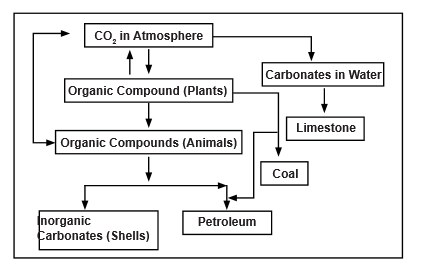
  • Carbon is a constituent of all organic compounds, many of which are essential to life on Earth. Carbon dioxide is an atmospheric constituent that plays several vital roles in the environment.
  • It is a greenhouse gas that traps infrared radiation heat in the atmosphere.
  • It plays a crucial role in the weathering of rocks. It is the carbon source for plants.
  • It is stored in biomass, organic matter in sediments, and in carbonate rocks like limestone.
Steps in Carbon Cycle
  • Carbon enters the atmosphere as carbon dioxide from respiration and combustion.
  • Carbon dioxide is absorbed by producers to make carbohydrates in photosynthesis.
  • Animals feed on the plant passing the carbon compounds along the food chain. Most of the carbon they consume is exhaled as carbon dioxide formed during respiration. The animals and plants eventually die.
  • The dead organisms are eaten by decomposers and the carbon in their bodies is returned to the atmosphere as carbon dioxide. In some conditions decomposition is blocked. The plant and animal material may then be available as fossil fuel in the future for combustion.
  
The cycle has four major reservoirs of carbon interconnected by pathways of exchange. The reservoirs are:
  • The atmosphere
  • The terrestrial biosphere (which usually includes freshwater systems and non-living organic material, such as soil carbon)
  • The oceans (which includes dissolved inorganic carbon and living and non-living marine biota).
  • The sediments (which includes fossil fuels).  
The annual movements of carbon, the carbon exchanges between reservoirs, occur because of various chemical, physical, geological, and biological processes.

HYDROLOGICAL CYCLE

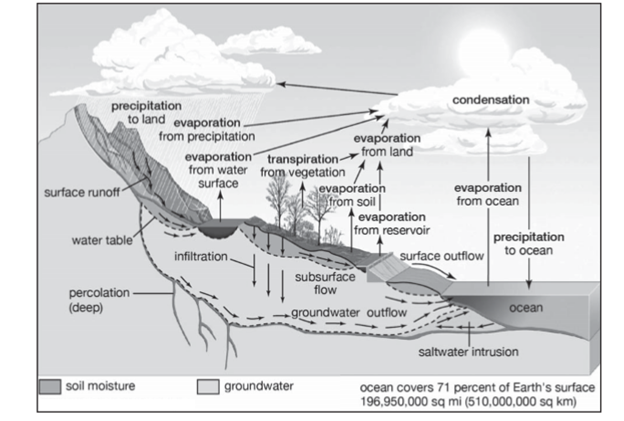
Water cycle, also called hydrologic cycle, cycle that involves the continuous circulation of water in the Earth atmosphere system. Of the many processes involved in the water cycle, the most important are evaporation, transpiration, condensation, precipitation, and runoff. Although the total amount of water within the cycle remains essentially constant, its distribution among the various processes is continually changing.

Different Steps of the Hydrological Cycle
Evaporation
  • Evaporation, one of the major processes in the cycle, is the transfer of water from the surface of the Earth to the atmosphere. By evaporation, water in the liquid state is transferred to the gaseous, or vapour, state.
  • This transfer occurs when some molecules in water mass have attained sufficient kinetic energy to eject themselves from the water surface. The main factors affecting evaporation are temperature, humidity, wind speed, and solar radiation.
Transpiration
  • When water vapour is also discharged from plant leaves by a process called transpiration.
Sublimation
  • Evaporation from snow and ice, the direct conversion from solid to vapor is known as sublimation.
Condensation
  • When water vapour rises, it cools slightly and condenses. Generally, the water condenses on dust particles in the air and becomes liquid. Sometimes the water skips the liquid phase and turns directly into a solid - in the form of ice, hail, or snow. In the liquid form the particles collect and form clouds.
  • Condensation may take place as soon as the air contains more water vapour than it can receive from a free water surface through evaporation at the prevailing temperature. This condition occurs as the consequence of either cooling or the mixing of air masses of different temperatures. By condensation, water vapour in the atmosphere is released to form precipitation.
Precipitation
  • The condensed water vapor falling to the surface of the Earth is known as precipitation. It occurs in the form of snow, hail and rain.
Infiltration and Percolation
  • When precipitation falls on the ground, some of it moves downwards into cracks, joints, and pores in the soil. The entry of water into the subsurface is termed infiltration.
  • The process of percolation refers to the subsequent movement of water through subsurface soil pores until it reaches the water table. At this point it becomes groundwater. This is a slow process, which is why more water flows back to the ocean through surface runoff than groundwater discharge
Groundwater Flow
  • Groundwater is water that is held in cracks and pore spaces below ground. This water can be tapped by water supply wells or continue moving below the ground until it eventually returns to the surface.
  • The process by which groundwater exits the ground is known as groundwater discharge. This groundwater can either discharge directly into oceans, or more commonly, it discharges to surface water (lakes and rivers) and then travels to the ocean as surface runoff.

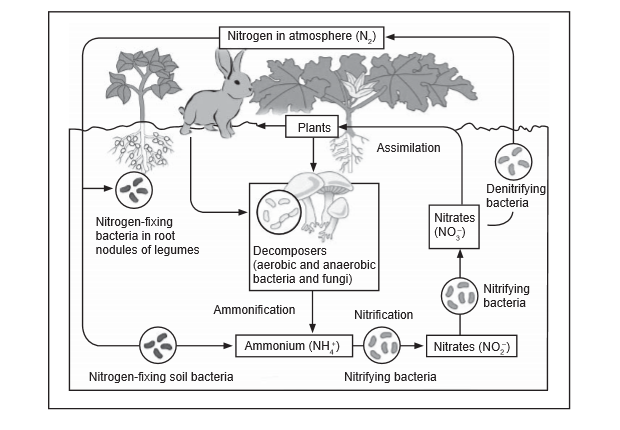
NITROGEN CYCLE

Nitrogen is an essential component of protein and required by all living organisms including human beings. Nitrogen is needed for our DNA, RNA and proteins and is critical to human agriculture. Nitrogen, a component of proteins and nucleic acids, is essential to life on Earth. Although 78% by volume of the atmosphere is nitrogen gas, this abundant reservoir exists in a form unusable by most organisms. Through a series of microbial transformations, however, nitrogen is made available to plants, which in turn ultimately sustain all animal life.
The steps, which are not altogether sequential, fall into the following classifications:
Nitrogen Fixation
  • Nitrogen enters the living world by way of bacteria and other single-celled prokaryotes, which convert atmospheric nitrogen N2—into biologically usable forms in a process called nitrogen fixation. Some species of nitrogen-fixing bacteria are free-living in soil or water, while others are beneficial symbionts that live inside of plants.
  • Nitrogen-fixing microorganisms capture atmospheric nitrogen by converting it to ammonia (NH3) which can be taken up by plants and used to make organic molecules. The nitrogen-containing molecules are passed to animals when the plants are eaten. They may be incorporated into the animal’s body or broken down and excreted as waste, such as the urea found in urine.
  • Nitrogen fixation, in which nitrogen gas is converted into inorganic nitrogen compounds, is mostly (90 percent) accomplished by certain bacteria and blue-green algae (see nitrogen fixation). A much smaller amount of free nitrogen is fixed by abiotic means (e.g., lightning, ultraviolet radiation, electrical equipment) and by conversion to ammonia through the Haber-Bosch process.
  • Nitrates and ammonia resulting from nitrogen fixation are assimilated into the specific tissue compounds of algae and higher plants. Animals then ingest these algae and plants, converting them into their own body compounds
Ammonification
  • When plants or animal die organic nitrogen is again released back into the soil. Bacteria or fungi present in the soil convert them back into ammonium. This process is also called as
  • The remains of all living things and their waste products are decomposed by microorganisms in the process of ammonification, which yields ammonia. (Under anaerobic, or oxygen-free, conditions foul-smelling putrefactive products may appear, but they too are converted to ammonia in time.) Ammonia can leave the soil or be converted into other nitrogen compounds, depending in part on soil conditions.
Nitrification
  • In this process, the ammonia is converted into nitrate by the presence of bacteria in the soil. Ammonia is oxidized to form nitrites by bacteria such as Nitrosomonas species. Nitrates are converted into nitrates by Nitrobacter. This conversion is very important as ammonia gas is toxic for plants.
Denitrification
  • Denitrification is the process that converts nitrate to nitrogen gas, thus removing bioavailable nitrogen and returning it to the atmosphere. Dinitrogen gas (N2) is the ultimate end product of denitrification, but other intermediate gaseous forms of nitrogen exists. Some of these gases, such as nitrous oxide (N2O), are considered greenhouse gases, reacting with ozone and contributing to air pollution.
  • Unlike nitrification, denitrification is an anaerobic process, occurring mostly in soils and sediments and anoxic zones in lakes and oceans.

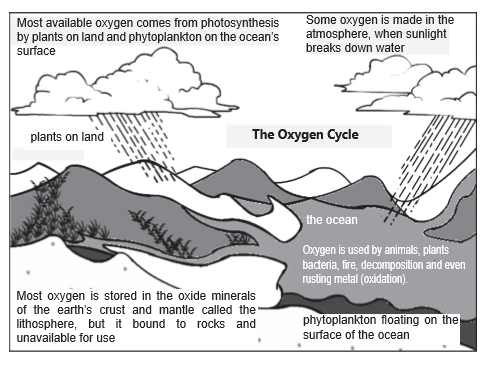
OXYGEN CYCLE

  • Oxygen in the atmosphere is about 21%, and it is the second most abundant gas after nitrogen.
  • It is mostly utilized by living organisms, especially man and animals in respiration.
  • Oxygen is also the most common element of human body. Oxygen is also used during combustion, decomposition, and oxidation.
  • The circulation of oxygen is through three main flow systems including the (air) atmosphere, the biosphere, and the earth’s crust.
  • In the oxygen cycle, the main driving factor is photosynthesis which is the process whereby green plants and algae make their own food by use of solar energy, water, and carbon dioxide to gives off oxygen as a by-product.
  • Hence, for oxygen to remain in the atmosphere, it has to circulate through various forms of nature which is essentially termed as the oxygen cycle. The circulation depends on the various activities on Earth.
Oxygen is produced by:
  • Plants – Plants produce oxygen via photosynthesis
  • Sunlight – Some oxygen is produced when sunlight reacts with water vapour in the atmosphere.
Oxygen is used up in:
  • Respiration – All organisms use oxygen for respiration.
  • Decomposing– When plants and animals die, they decompose. This process uses up oxygen and releases carbon dioxide into the air.
  • Rusting – Also called oxidation, this process causes metals to rust. Also a process which uses up oxygen.
  • Combustion– The process by which fire is generated also requires oxygen, along with heat and fuel. This process also uses up oxygen and releases carbon di oxide into the atmosphere.

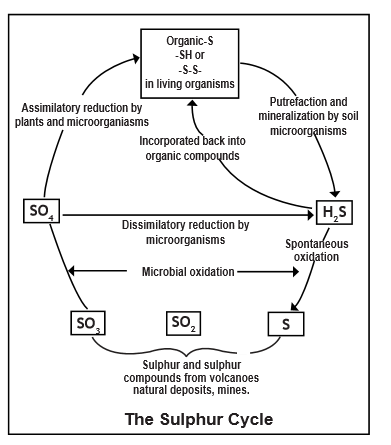
SULPHUR CYCLE

  • The sulphur reservoir is in the soil and sediments where it is locked in organic (coal, oil and peat) and inorganic deposits (pyrite rock and sulphur rock) in the form of sulphates, sulphides and organic sulphur.
  • It is released by weathering of rocks, erosional runoff and decomposition of organic matter and is carried to terrestrial and aquatic ecosystems in salt solution.
  • The sulphur cycle is mostly sedimentary except two of its compounds, hydrogen sulphide (H2S) and sulphur dioxide (SO2), which add a gaseous component.
  • Sulphur enters the atmosphere from several sources like volcanic eruptions, combustion of fossil fuels (coal, diesel etc.), from the surface of the ocean and gases released by decomposition.
  • Atmospheric hydrogen sulphide also gets oxidised into sulphur dioxide.
  • Atmospheric sulphur dioxide is carried back to the earth after being dissolved in rainwater as weak sulphuric acid (acid rain).
  • Whatever the source, sulphur in the form of sulphates is taken up by plants and incorporated through a series of metabolic processes into sulphur bearing amino acid which is incorporated in the proteins of autotroph tissues. It then passes through the grazing food chain.
  • Sulphur bound in a living organism is carried back to the soil, to the bottom of ponds and lakes and seas through excretion and decomposition of dead organic material.
     

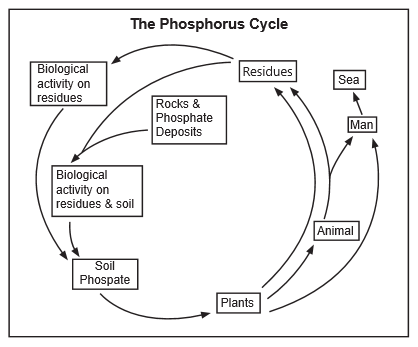
PHOSPHORUS CYCLE

  • Phosphorus is an essential nutrient for plants and animals.
  • It is a part of DNA molecules, of molecules that store energy (ATP and ADP) and of fats of cell membranes. Phosphorus is also a building block of certain parts of the human and animal body, such as the bones and teeth.
  • Phosphorus can be found on earth in water, soil and sediments. Unlike the compounds of other matter cycles phosphorus cannot be found in air in the gaseous state. This is because phosphorus is usually liquid at normal temperatures and pressures. It is mainly cycling through water, soil and sediments. In the atmosphere phosphorus can mainly be found as very small dust particles.
  • Phosphorus moves slowly from deposits on land and in sediments, to living organisms, and then much more slowly back into the soil and water sediment. The phosphorus cycle is the slowest one of the matter cycles. The phosphorus cycle appears somewhat simpler than the nitrogen cycle, because phosphorus occurs in fewer chemical forms.
Parts of the Cycle
  • As shown in the Figure, phosphorus, a necessary constituent of protoplasm, tends to circulate with organic compounds in the form of phosphates (PO4), which are again available to plants.
  • The great reservoir of phosphorus is not the air, however, but in apatite mineral deposits formed in past geological ages (that is, in the lithosphere). Atmospheric dust and aerosols return a large amount of phosphorus (not phosphate) to the land yearly, but phosphate continually returns to the sea, where part of it is deposited in the shallow sediments and part of it is lost to the deep sediments.
  • Contrary to popular belief, seabirds play only a limited role in returning phosphorus to the cycle (as shown by the guano deposits located on the coast of Peru). This transfer of phosphorus and other materials by birds from the sea to the land is continuing, likely at the same rate at which it occurred in the past - but these guano deposits have been mined out